
TPM stands for Total Productive Maintenance. It's a system focused on maximizing the effectiveness of production equipment by involving all levels and functions within an organization. This comprehensive approach aims to eliminate losses related to equipment failures, defects, and other inefficiencies.
TPM was developed in Japan in the 1950s and 1970s by Seiichi Nakajima, who is considered the father of TPM. He integrated the best practices of preventive and predictive maintenance, as well as employee involvement and continuous improvement, into one systematic approach. TPM was first applied in Nippondenso, a supplier of Toyota, and later became widely adopted by many Japanese and global companies. TPM is also recognized as an international standard by the ISO/IEC 11889.
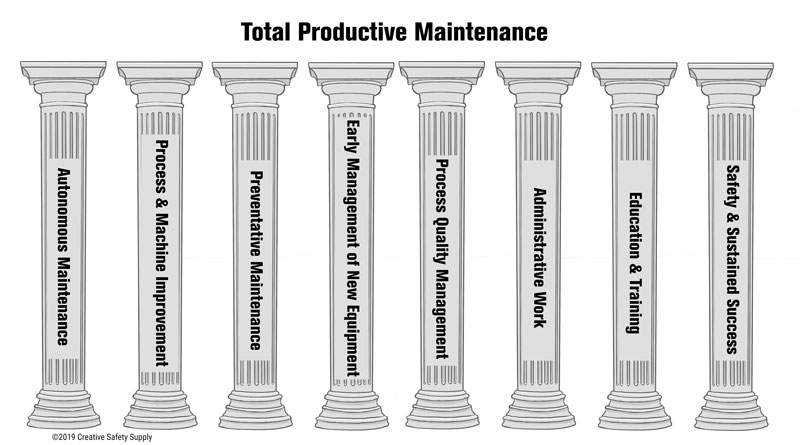
Core Principles of Total Productive Maintenance (TPM)
TPM has eight core pillars that guide its implementation: autonomous maintenance, focused improvement, planned maintenance, quality maintenance, early equipment management, training and education, office TPM, and safety, health, and environment. These pillars work together to achieve "perfect production" by striving for zero unplanned breakdowns, zero defects, and zero accidents.
- Autonomous Maintenance
- Focused Improvement
- Planned Maintenance
- Quality Maintenance
- Early Equipment Management
- Training and Education
- Office TPM
- Safety, Health, and Environment
Key TPM Metrics
The benefits of TPM are manifold and can be measured by various indicators, such as:
- Overall Equipment Effectiveness (OEE)
- Mean Time Between Failures (MTBF)
- Mean Time To Repair (MTTR)
- Planned Maintenance Ratio (PMR)
- Rate of Improvement (ROI)
- Employee Involvement Index (EII)
These metrics help assess the effectiveness of TPM implementation in improving equipment performance, reducing downtime, and enhancing overall operational efficiency.
TPM in Other Manufacturing Methodologies
TPM is also related to other concepts that share similar goals and principles, such as lean manufacturing, total quality management, and trusted computing. TPM, focusing on equipment effectiveness and reliability, directly supports Lean's waste reduction efforts and TQM's quality focus. By integrating these approaches, organizations can achieve a more streamlined, productive, and competitive operational environment.
Additional TPM facts:
- According to a study by the Japan Institute of Plant Maintenance (JIPM), the average improvement rate of OEE (Overall Equipment Effectiveness) after implementing TPM was 59%, and the average reduction rate of breakdown losses was 88%. The study also found that TPM had positive effects on other performance indicators, such as productivity, quality, delivery, cost, safety, and morale. Source: https://www.dynaway.com/blog/the-total-productive-maintenance-tpm
- According to a survey by the Aberdeen Group, the best-in-class manufacturers that adopted TPM achieved an average OEE of 90%, compared to 76% for the industry average and 66% for the laggards. The survey also revealed that the best-in-class manufacturers had 3 times lower unscheduled downtime, 4 times lower injury rate, and 26% higher profit margin than the laggards. Source: https://website.maintenanceconnection.com/resources/blog-posts/improving-manufacturing-overall-equipment-effectiveness-oee-cmms
- According to a report by the World Class Manufacturing Association (WCMA), the top three benefits of TPM reported by the member companies were improved equipment reliability, improved product quality, and improved employee involvement. The report also identified the top three challenges of TPM implementation as changing the organizational culture, sustaining the improvement activities, and measuring the results. Source: https://world-class-manufacturing.com/tpm/
- According to a case study by the International Journal of Engineering Research and Technology (IJERT), the implementation of TPM in a textile industry resulted in a significant improvement in the performance of the spinning machines, such as reducing the breakdown time by 71%, reducing the defects by 62%, and increasing the production by 27%. The case study also estimated that the annual savings due to TPM implementation were around 2.5 million Indian rupees. Source: https://www.ijert.org/
- According to a research paper by the International Journal of Scientific and Research Publications (IJSRP), the implementation of TPM in a cement industry led to a remarkable improvement in the performance of the kiln and the cement mill, such as increasing the availability by 11%, reducing the downtime by 74%, and reducing the energy consumption by 8%. The research paper also calculated that the annual savings due to TPM implementation were around 51.8 million Nigerian naira. Source: https://www.ijsrp.org/
Similar Questions
- How are TPM and Lean related?
- Who developed TPM?
- What are the pillars of TPM?
- What is the difference between TPM and TQM?
- What are some tools of TPM?
- How does TPM relate to OEE?
- What are the steps to implementing TPM?
- How can I use visual communication in TPM?
- What are the objectives of TPM?

